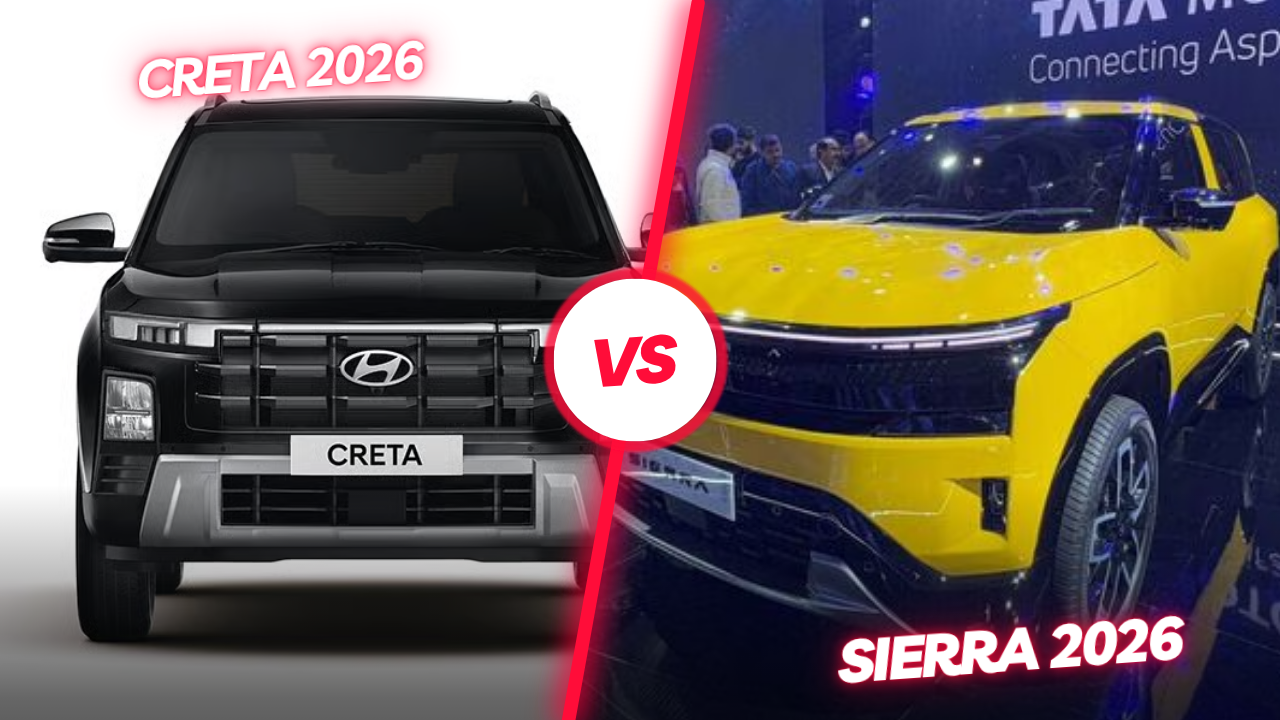

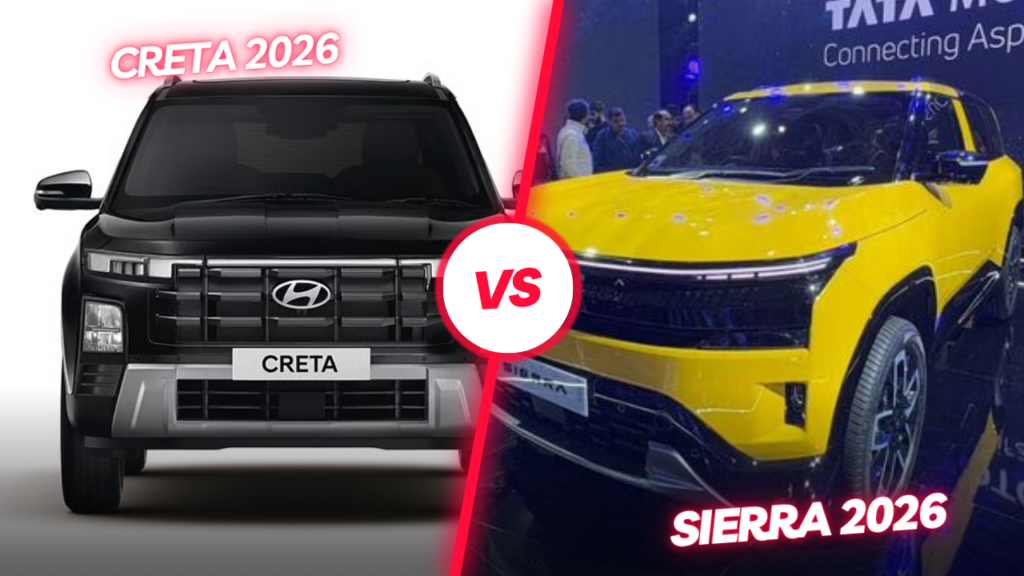
This is probably the most searched comparison in the midsize SUV segment right now, and for good reason. The Tata Sierra has walked straight into the space the Hyundai Creta has owned for years. Both are 5-seat, front-wheel-drive SUVs with petrol and diesel engine options, a long list of features, and prices that start under Rs 12 lakh and stretch well past Rs 20 lakh. On paper they look similar. In reality, they are quite different cars built for different kinds of buyers.
The Creta has spent years being the safe, sensible answer in this segment. The Sierra is the new one trying to shake things up. So here is a straight look at how these two actually compare.
Also Read: Tata Sierra 2026: Price, Specs, Variants And Everything You Need To Know
Price: How Do They Compare?
The Hyundai Creta starts at Rs 10.73 lakh ex-showroom and goes up to Rs 20.20 lakh for the top-spec SX(O) automatic variant. The Tata Sierra starts at Rs 11.49 lakh and tops out at Rs 21.29 lakh for the Accomplished Plus diesel automatic.
So the Tata Sierra is slightly more expensive across the range. The Hyundai Creta’s turbo-petrol DCT costs at least Rs 94,000 less than the Sierra with a similar powertrain. The diesel top-spec Creta is cheaper than the Sierra by at least Rs 1.35 lakh for the manual and Rs 1.09 lakh for the automatic.
For buyers comparing top-end variants specifically, the Creta offers more for less on price. But the Sierra brings a longer feature list in some areas that justify the gap, depending on what matters to the individual buyer. More on that below.
Design: Familiar Vs Fresh
This is where the two cars differ the most. The Creta follows a relatively conventional upright SUV shape, refined with each generation. The 2024 facelift brought a black chrome parametric grille, horizon LED DRLs, quad-beam headlamps, and connected LED tail lamps at the rear. It looks sharp and premium without being polarising, which is exactly why it sells in the numbers it does.
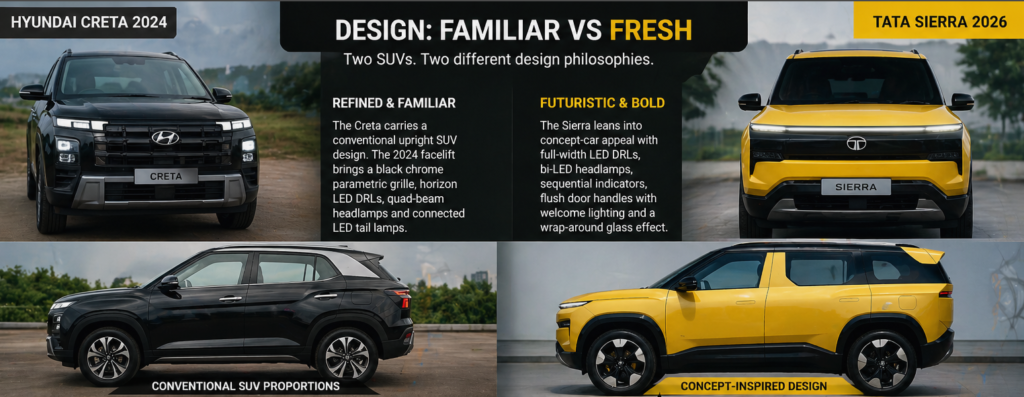
The Sierra leans hard into nostalgia and concept-car appeal, with full-width LED DRLs, bi-LED headlamps, sequential indicators, flush door handles with welcome lighting, and a wrap-around glass effect. Higher trims add 19-inch alloy wheels, roof rails, a hidden rear wiper, and a gesture-controlled powered tailgate. It has even won a Red Dot Design Award.
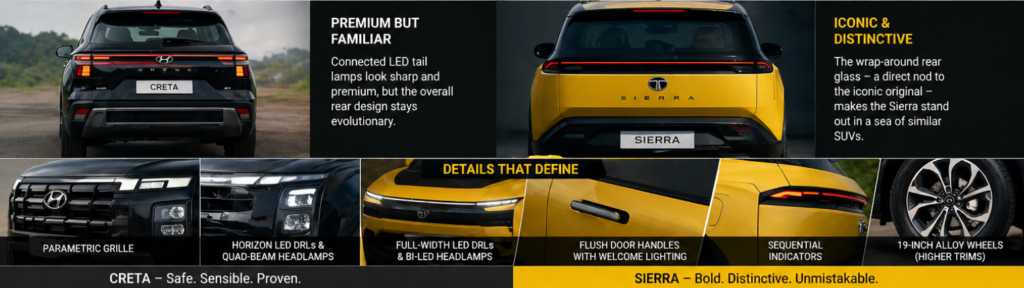
The Sierra’s rear glass section, which is a direct reference to the iconic original, is what turns heads most. In a segment where most SUVs look broadly similar from behind, that rear-end treatment makes the Sierra genuinely distinctive. If standing out on the road matters, the Sierra wins this round without much debate.
Size And Space: Sierra Has The Clear Edge
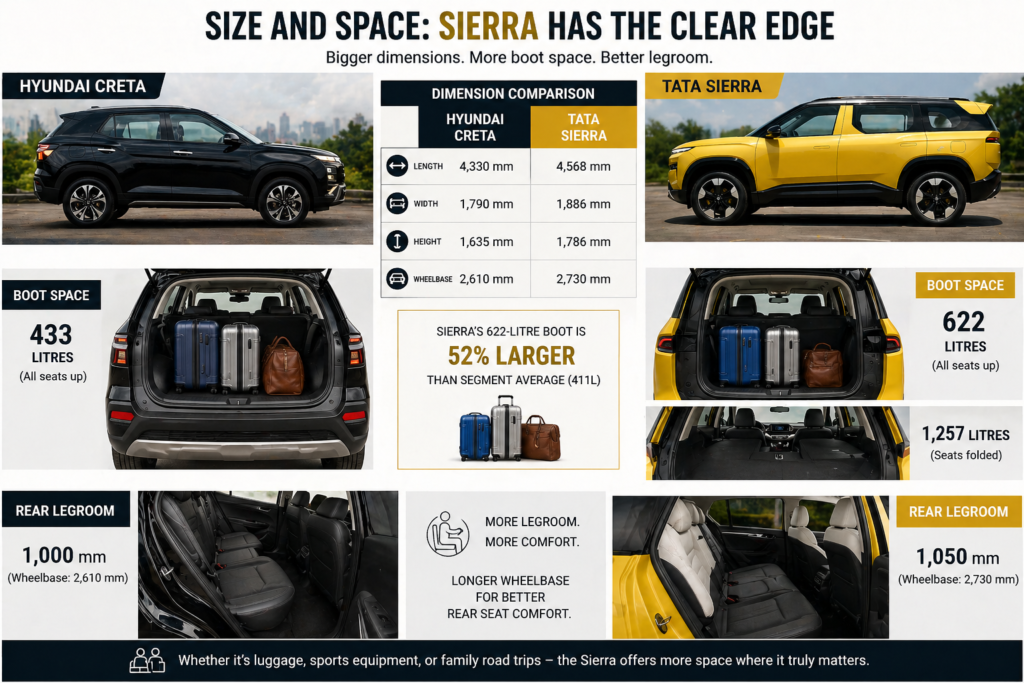
On paper, the Sierra is slightly larger and clearly aims for a one-size-above feel. Boot space is a highlight, with Tata claiming a segment-leading 622 litres with all seats up, going up to 1,257 litres with seats folded. The Creta is a touch smaller in every direction: 4,330 mm long, 1,790 mm wide, 1,635 mm high, and with a 2,610 mm wheelbase. Real-world boot volume sits at a useful 433 litres.
The Sierra’s 622-litre boot is about 52 per cent larger than the segment average of around 411 litres. The wheelbase of 2,730 mm also gives the Sierra noticeably better rear legroom, which matters on longer family road trips. For buyers who regularly carry luggage, sports equipment, or simply travel with the full family on highways, this is a meaningful difference.
Interior And Features: Two Different Philosophies
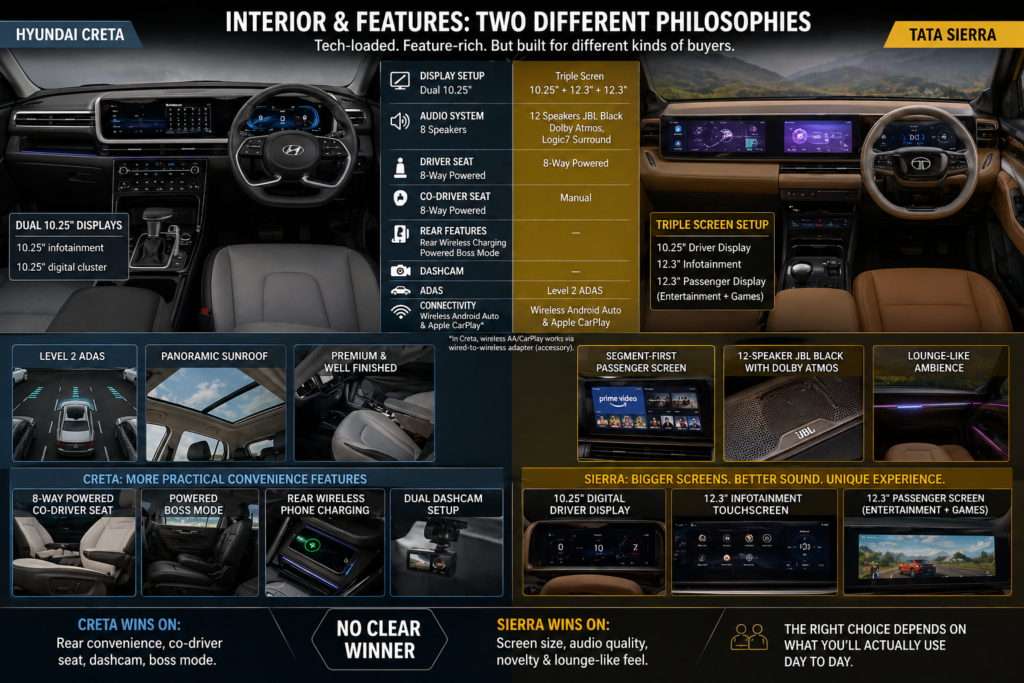
Inside, the Creta offers dual 10.25-inch displays, Level 2 ADAS, an 8-way powered driver seat with an 8-way powered co-driver seat, a panoramic sunroof, rear wireless charging, and a dual dashcam setup. The cabin is well put together and the overall quality feel is consistent across most touchpoints.
The Sierra goes for a lounge-like feel inside. Top trims get the triple-screen setup: a 10.25-inch digital driver display, a 12.3-inch central infotainment screen, and a 12.3-inch passenger display under a single glass panel. The passenger screen can stream content and play games independently, which is a segment first. The Sierra also runs a 12-speaker JBL Black system with Dolby Atmos and Logic7 surround sound, compared to the Creta’s 8-speaker setup.
The Creta, however, offers a powered co-driver seat, powered boss mode, wireless phone charging for rear passengers, and dual dashcams, all of which the Sierra lacks despite its higher price. Both models support wireless Android Auto and Apple CarPlay, though in the Creta this works through a wired-to-wireless adapter provided as an accessory.
So the Sierra wins on screen size, audio quality, and the novelty of the passenger display. The Creta wins on rear convenience features and the co-driver seat setup. Neither is a clear knockout, and the right answer depends on what the buyer will actually use day to day.
Engine And Powertrain: Similar Numbers, Different Character
Both cars offer 1.5-litre petrol and diesel options in the same broad power bracket.
Both turbo-petrol variants produce 160 bhp, with the Sierra’s unit making 2 Nm more torque, a negligible difference that will not be noticeable in real-world conditions. The Sierra’s turbo-petrol comes with a torque-converter automatic, while the Creta uses a 7-speed DCT.
In city traffic, the Sierra’s torque-converter automatic is smoother and more relaxed than the Creta’s DCT, which can feel slightly jerky at very low speeds. On highways, both are competent. The diesel variants in both cars are genuinely efficient, with the Creta diesel claiming 21.8 kmpl and the Sierra diesel returning 19.22 to 21.26 kmpl as per ARAI figures.
One notable difference is the Sierra’s Hyperion 1.5-litre direct-injection turbo-petrol engine, which is Tata’s first DI turbo-petrol and marks a meaningful step up in refinement for the brand. Sierra’s diesel also skips the need for AdBlue or DEF fluid, which is a quiet but practical advantage for buyers in smaller cities.
Safety: Both Are Strong, Sierra Edges Ahead On Paper
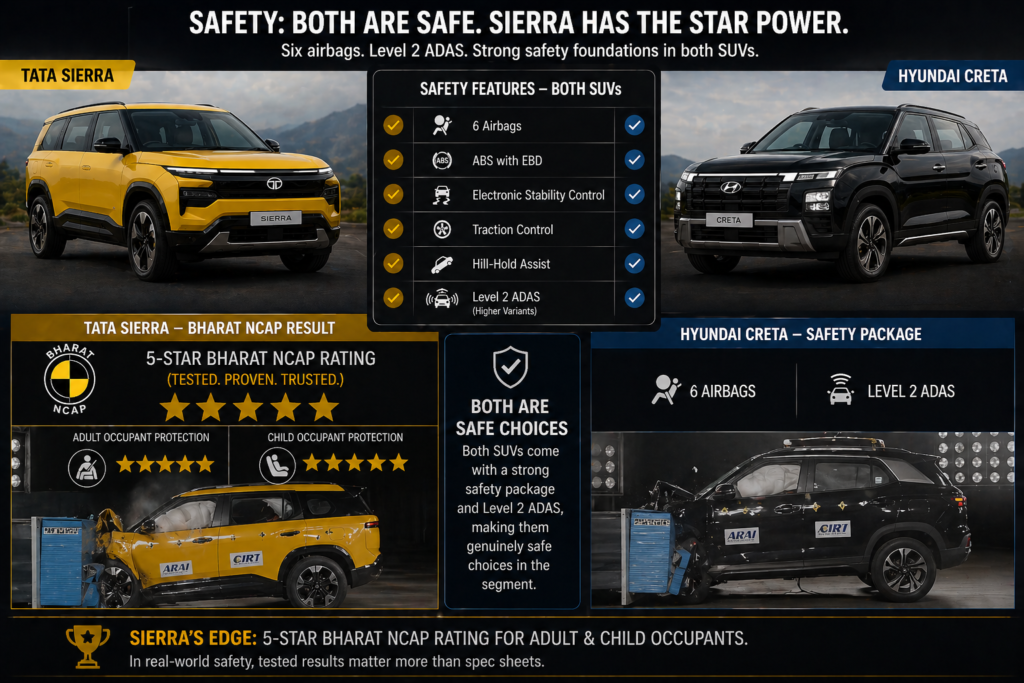
The Tata Sierra comes with six airbags, ABS with EBD, electronic stability control, traction control, hill-hold assist, and Level 2 ADAS on higher variants. It has received a 5-star Bharat NCAP rating for both adult and child occupant protection.
The Hyundai Creta also carries a strong safety package with six airbags and Level 2 ADAS. Both cars are genuinely safe choices in this segment. The Sierra’s 5-star Bharat NCAP result is its most important credential in this area, as tested results carry more weight than spec-sheet claims.
Tata Sierra Vs Hyundai Creta: Which One Should You Buy?
This really comes down to what kind of buyer is reading this.
The Hyundai Creta makes sense for buyers who want a proven, well-rounded midsize SUV at a slightly lower price, with a very mature ownership experience, wide service network, consistent resale value, and a feature set that covers all the practical bases. The Creta’s 62 variants also give buyers a lot of room to find the right spec at the right price. It is not a flashy choice, but it is the right one for a large number of families.
The Tata Sierra makes sense for buyers who want something that looks and feels different from everything else in the segment, have a genuine use for the class-leading boot space, want the triple-screen interior and 12-speaker audio setup, and are comfortable with Tata’s improving but still maturing service network. The Sierra is also the better pick for buyers doing long highway runs regularly, where the larger cabin, smoother torque-converter automatic, and superior boot space all add up.
On pure value at the top end, the Creta feels the more rounded option as it comes at a considerably lower price while offering features such as a powered co-driver seat, rear wireless charging, and dual dashcams that the Sierra lacks. But if the passenger screen, the audio system, and the design are priorities, the Sierra justifies its premium.
Both are good cars. The segment is better for having both of them in it.
Stay tuned to NeeMoto.com for on-road price updates, ownership reviews, and the Tata Sierra EV vs Creta EV comparison when that arrives later in 2026.
You’re right. The Tata Sierra vs Hyundai Creta article was missing the FAQs. Here they are:
Frequently Asked Questions: Tata Sierra Vs Hyundai Creta 2026
Q1. Which is better, Tata Sierra or Hyundai Creta? Both are strong choices but for different buyers. The Tata Sierra is better for those who want more boot space, a larger interior screen setup, stronger audio, and a more distinctive design. The Hyundai Creta is better for buyers who want a slightly lower price, a more proven ownership experience, and convenience features like rear wireless charging and a powered co-driver seat.
Q2. What is the price difference between Tata Sierra and Hyundai Creta? The Hyundai Creta starts at Rs 10.73 lakh ex-showroom while the Tata Sierra starts at Rs 11.49 lakh. At the top end, the Creta’s diesel automatic is cheaper than the Sierra’s equivalent by around Rs 1.09 lakh to Rs 1.35 lakh depending on transmission choice.
Q3. Which has more boot space, Tata Sierra or Hyundai Creta? The Tata Sierra offers 622 litres of boot space, which is significantly more than the Hyundai Creta’s 433 litres. With rear seats folded, the Sierra goes up to 1,257 litres, making it the clear winner for families who travel with a lot of luggage.
Q4. Which is safer, Tata Sierra or Hyundai Creta? Both carry strong safety credentials. The Tata Sierra holds a 5-star Bharat NCAP rating and comes with 6 airbags and Level 2 ADAS on higher variants. The Hyundai Creta also offers 6 airbags and Level 2 ADAS. On tested crash results, the Sierra currently holds the stronger rating.
Q5. Does Tata Sierra have better mileage than Hyundai Creta? The Hyundai Creta diesel claims 21.8 kmpl as per ARAI figures, which is marginally better than the Sierra diesel’s 19.22 to 21.26 kmpl range. In real-world conditions, both cars return broadly similar fuel efficiency on highways. The Creta petrol also has a slight mileage edge in urban conditions.
Q6. Which has a better infotainment system, Tata Sierra or Hyundai Creta? The Tata Sierra wins on screen size and count. It gets a triple-screen setup with a 12.3-inch central display and a dedicated 12.3-inch front passenger screen, which is a segment first. The Creta gets dual 10.25-inch screens. However, the Creta supports wireless Android Auto and Apple CarPlay while the Sierra requires a wired-to-wireless adapter for the same.