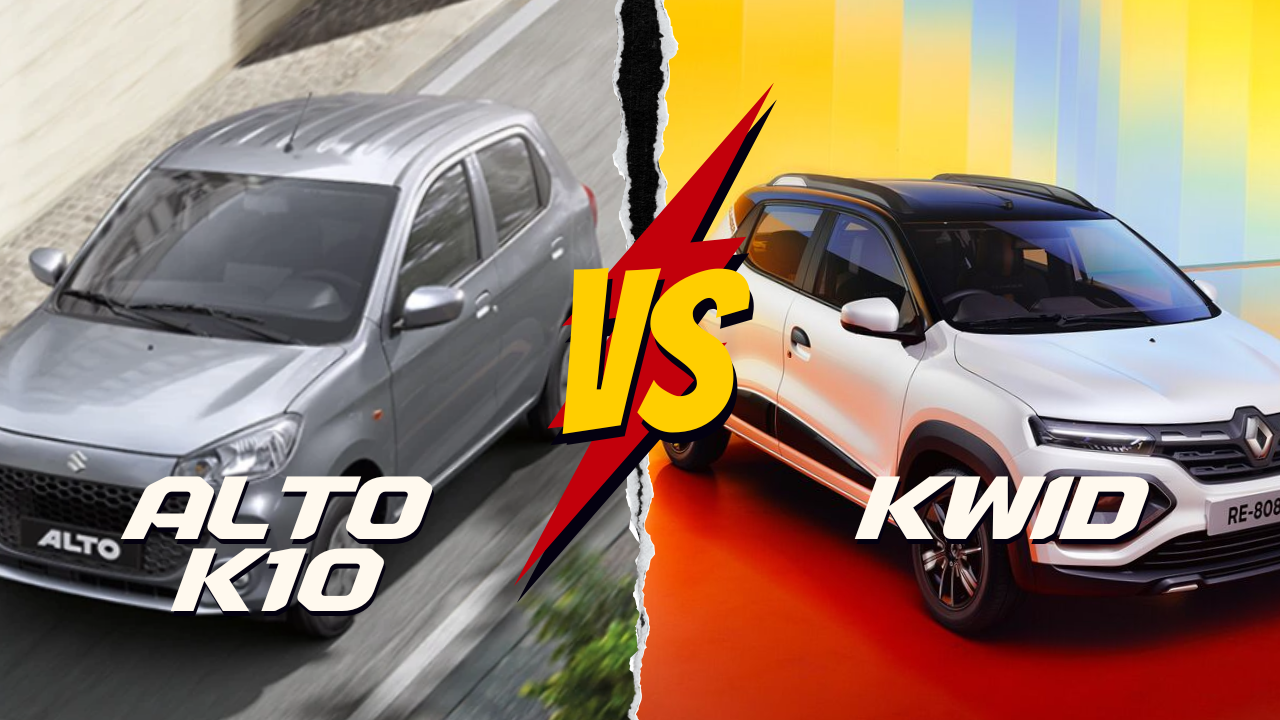

Ever get stuck choosing between two cute city cars? That’s where Maruti Alto K10 and Renault Kwid collide. Both are small, budget-friendly hatchbacks, but each has its own tricks up its sleeve. Think of Alto as a zippy, fuel-smart buddy and Kwid as the taller, SUV-styled cousin. Let’s dive into their quirks and see which one might fit your life best.
Price & Variants: Budget-Friendly Vs Stylist
You’ll smile at the price tags. The Alto K10 starts around ₹3.70 lakh (ex-showroom) for the basic model and goes up to about ₹5.45 lakh for the top-spec automatic. The Kwid, meanwhile, starts at roughly ₹4.30 lakh and tops out near ₹5.99 lakh. In simple terms: Alto is cheaper to begin with.
After 2025’s GST cuts, Alto got even more wallet-friendly – its starting price dropped by over ₹50,000. But Kwid fights back with flashy variants: there’s a Climber edition with sporty graphics and roof rails. And fun fact: Renault’s 10th-anniversary Kwid launched at about ₹5.14 lakh (manual) and ₹5.63 lakh (AMT). So if you crave style poking out at you, Kwid has a few specials Alto doesn’t.
Don’t forget fuel options: Alto can use CNG (cheaper fuel), while Kwid has a CNG option only in certain trims. This means Alto can be extra thrifty at the pump.
Design & Space: Compact Cube vs Mini-SUV
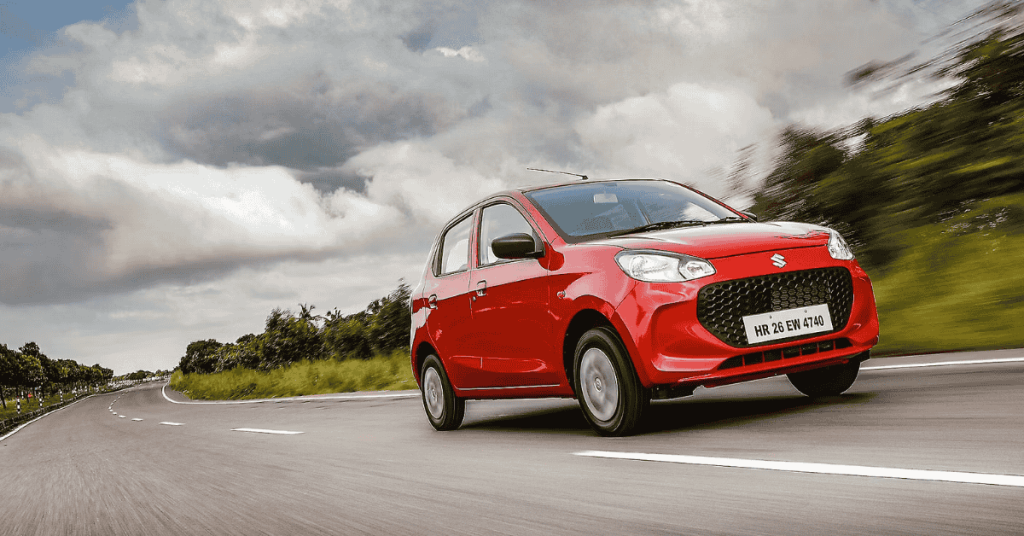
On paper, Alto K10 is shorter and narrower than Kwid. Length: Alto about 3,530 mm, Kwid 3,731 mm. Width: Alto 1,490 mm, Kwid 1,579 mm. Kwid also rides taller off the road (about 184 mm ground clearance) and has a longer wheelbase (2,500 mm vs Alto’s 2,380 mm).
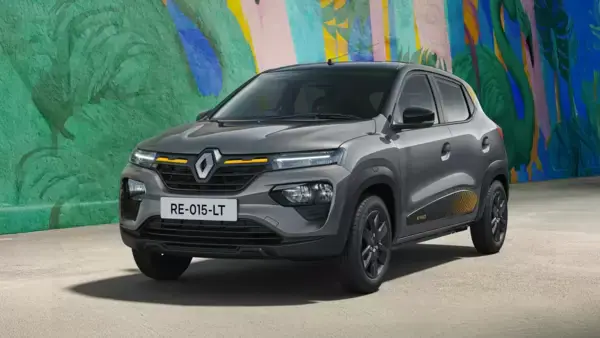
What does that mean inside? Kwid feels airier – it’s like a mini-SUV design with roof rails and cladding. Its boot is big too: 279 litres vs Alto’s 214 litres. Push the rear seats down, and Kwid’s space balloons (it can reach ~620L with seats folded, which is absurd for such a small car!).
Alto’s shape is more classic boxy-hatch. It’s tall enough to give decent headroom, but overall it’s snugger. That makes Alto extra nimble in tight city parking. If you’re squeezing between cars, Alto’s small size and light steering feel effortless. Kwid, on the other hand, gives a roomier feel for four people. But full five-adult trips can be a squeeze.
Engine & Mileage: Economy Kings (Almost)
Both use ~1.0-litre engines, but they tune them a bit differently. Alto K10 has a 998 cc three-cylinder engine (Maruti’s famous K10C engine) putting out about 68 bhp. Kwid has a 999 cc three-cylinder SCe engine with roughly 67 bhp. The numbers are almost twins. Torque is similar too (Alto ~91 Nm, Kwid ~91 Nm).
On the road, Alto feels peppy for its size. Its 1.0L revs nicely, and it’s light on its feet at low speeds. Kwid also gets the job done, but with a slightly heavier nose (because of that bigger body). For city drives, both will happily zip through.
Fuel economy is where Alto stretches an edge. Alto’s manual returned around 14.5 km/l in the city and 21.8 km/l on highway in one test (with AMT you’d see similar). Kwid’s petrol model officially claims about 21–22 km/l. Actual driving is about the same – Alto might do a few km more per litre. If you go CNG in the Alto, you could see ~30+ km per kg of gas (that’s marvellously cheap!). Kwid’s CNG gives around 22 km/kg as per some tests, but Kwid’s CNG is only in a couple trims anyway.
The takeaway? Both cars sip fuel instead of slurping. Alto tends to be a little more frugal thanks to lighter weight and shorter gearing. Kwid compensates with a bit more torque feel, especially useful if you load it with cargo or hit steep hills.
Features & Safety: Modern Tech vs Budget Sense
Inside, Kwid tries to feel modern: it has an 8-inch touchscreen infotainment (Android Auto/Apple CarPlay ready), a digital instrument cluster, and even a digital park camera on higher trims. Alto’s cabin is simpler. Its latest versions do offer Maruti’s SmartPlay 7-inch screen (also with phone mirroring), but the dashboard is mostly basic plastics.
On convenience, Kwid has goodies like fold-flat rear seats (which boost boot to ~620L), keyless entry, power windows all around, and rear parking sensors. Alto has rear parking sensors too (newer Altos even get corner stability control). It also has power front windows and steering-mounted controls, but no fancy projector LEDs or roof rails – Kwid wins style points there.
Safety is a mixed bag. Alto K10 now comes standard with 6 airbags across all trims, ABS with EBD, and seat belt reminders. Kwid’s safety kit is decent too (dual airbags, ABS, ESC on climber trim), but six airbags only appear on the top “Climber” variant. Alarm bells: In crash tests, Alto K10 scored a 2-star (adult) rating from Global NCAP, while Kwid got just 1 star. That means Alto’s structure held up a bit better, according to testers. (Yikes!)
Comfort & Ride: City Hustle vs Bumpy Roads
Both cars are engineered for city life, so expect a firm ride. Alto’s suspension soaks up potholes reasonably well for its class, thanks to its 13-inch wheels and high-profile tyres. Kwid’s taller stance and twist-beam rear make it ride a bit bumpier on rough patches. However, Kwid’s extra width means it’s a bit more stable at speed. Alto can feel nervous above 80 km/h – it might sway or chatter.
Inside seating, Alto is tighter. Its rear seat is best for two; three adults would be squished. Kwid can technically seat five, but again it’s really comfy for four, with a flat floor and more shoulder room. The high roof in both helps headroom, though Alto’s roof is actually a bit higher (fun fact!). Both have basic interiors – hard plastics dominate. Kwid adds some gloss black trim and nifty dual-tone colour options that look sharper. Alto sticks to solids (silver, red, white, etc.), but even a plain Alto can be brightened up with decals or a custom paint job if you’re fun like that.
Other Contenders: S-Presso and Tiago
Just for context, Alto’s tall sibling is the Maruti S-Presso (also 998 cc), and a common rival is the Tata Tiago (1199 cc). The S-Presso shares almost the same price (about ₹3.50–3.70L) and engine/mileage as Alto. Tiago jumps in size and price (around ₹4.57L and a 1.2L engine). So while they’re cool cars, remember Alto and Kwid live in the budget city hatch lane, whereas Tiago plays closer to a more powerful mini-hatch segment.
Which One Should You Pick?
Imagine your daily drive. If every rupee counts and you live in jammed traffic, Alto K10 might be your buddy. It’s lighter, easier to park, and very frugal (especially on CNG). Its peppy 1.0L engine feels fun in the city, and you get full safety kit at a lower cost. It’s basically a no-nonsense survivor that won’t bore you.
If you want a car that looks a bit rugged and offers more room, the Kwid could win you over. It’s taller and can tackle speed bumps, plus those extra features (big touchscreen, AirPlay, rear camera) feel like luxuries in this class. The design is chunkier, so you might “see and be seen” better in traffic. But know the trade-off: it’s bulkier in traffic, slightly thirstier, and you’d ideally stick to higher trims for safety gear.
Either way, both Alto K10 and Kwid are easy on the wallet and fine for city life. You might even say it’s like choosing between plain caramel and chocolate swirl ice-cream – both taste sweet, just slightly different flavors. Check prices on the latest offers, book test drives if you can, and see which one feels like yours.
Don’t forget: both cars have big friendly user communities, so you can always ask current owners online about real-world comfort or service. And hey, if you do go for one of these little champs, consider leaving a review. After all, they’re both crowd-pleasers – Alto with its efficiency, Kwid with its style. You’ll be cruising with good company either way.
Also read: Driving the 2025 Alto K10 AGS – A Real-World Take
FAQs
Q: Which is better – Alto K10 or Kwid?
A: It depends on your priorities. Alto K10 is generally cheaper and more fuel-efficient, so it’s great for tight budgets and mileage. Kwid is roomier with a taller ride and more features, so it suits those wanting a bit more space and gadgetry. Safety-wise, Alto has a slight edge (2-star NCAP vs 1-star for Kwid).
Q: How do the prices compare?
A: The base Alto K10 starts at about ₹3.70 lakh (ex-showroom) while the Kwid starts around ₹4.30 lakh. Top variants see Alto up to ~₹5.45L, Kwid up to ~₹5.99L. Recent GST cuts made Alto even cheaper to begin with.
Q: Which car is larger in size?
A: The Renault Kwid is longer and wider than the Alto. Kwid is about 3731 mm long vs Alto’s 3530 mm, and Kwid’s width is 1579 mm vs Alto’s 1490 mm. Kwid also has more ground clearance (about 184 mm) and a larger boot (279 L vs 214 L). Alto is more compact, making it easier to park, but Kwid gives more cabin and cargo space.
Q: What about fuel efficiency and engine?
A: Both cars use ~1.0L 3-cylinder petrol engines (Alto’s is 998 cc, Kwid’s is 999 cc). Alto’s engine feels peppier around town. Fuel economy is similar: roughly 24 km/l (Alto, ARAI) vs about 22 km/l (Kwid). Alto also offers a CNG option, which can deliver upwards of 30 km/kg of gas. Kwid has CNG in select trims (~22 km/kg).
Q: Do they have important features?
A: Alto has basics like power steering, aircon, and Maruti’s SmartPlay touchscreen (7-inch). All models get 6 airbags, ABS, and rear parking sensors. Kwid packs more tech: an 8-inch touchscreen with CarPlay/Android Auto, a digital cluster, and on higher trims a reverse camera and hill-start assist. Kwid also offers funky dual-tone colors and roof rails that Alto doesn’t.
Q: Are Alto K10 and Kwid safe for city driving?
A: Both handle urban use well but have low crash-test ratings. Alto K10 got 2 stars for adult protection in NCAP tests, Kwid only 1 star. This means their crash safety is modest, which is common in this budget segment. City driving at low speeds is usually fine, but if safety is a top concern (especially for highways or family use), you might consider slightly safer alternatives or stick to the highest trims with all airbags.
Q: Which is the best value for money?
A: If value = lowest price + mileage + practicality, Alto K10 wins at the pump and has all safety gear for less money. If value = features + style, Kwid gives you more creature comforts and room at a modest extra cost. In either case, you get a reliable little car. Just think about whether you want an ultra-compact frugal car (Alto) or a bit more of an SUV-flavored ride (Kwid) – either can serve you well!.