
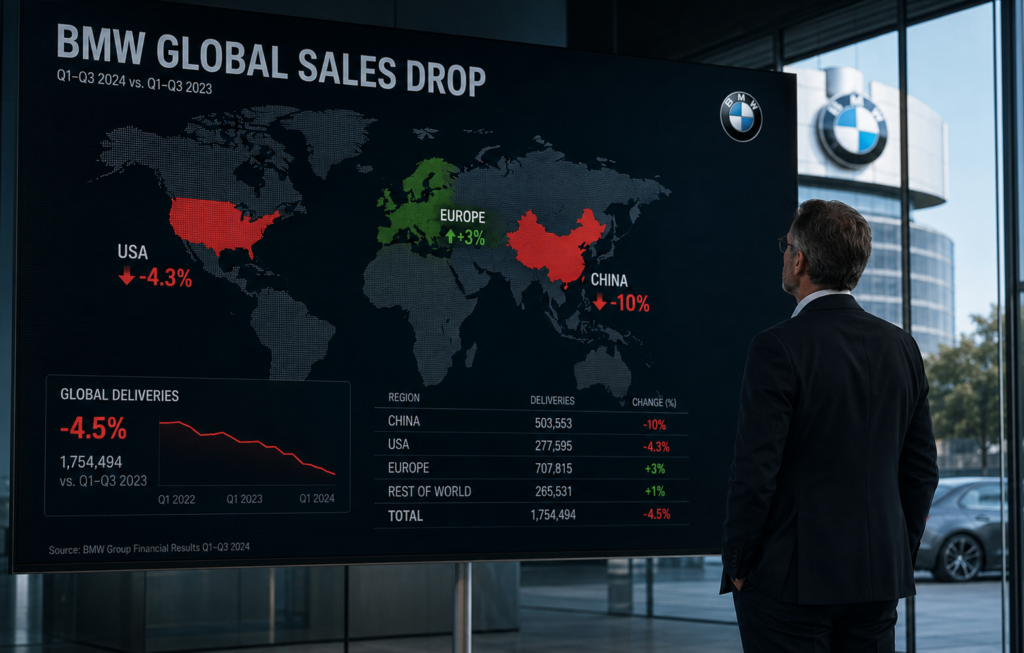
BMW Group sold 565,780 vehicles globally in Q1 2026, a 3.5% drop compared to Q1 2025. The biggest damage came from China (down 10%) and the United States (down 4.3%). But here is the twist: BMW India actually grew 17%, selling 4,567 units in Q1 2026 versus 3,914 last year. So the global picture and the Indian picture are telling two completely different stories.
Here is the full breakdown with actual numbers, model-wise sales, India pricing, and what this means if you are considering buying a BMW in India this year.
BMW Global Sales: Q1 2026 vs Q1 2025
| Region | Q1 2025 | Q1 2026 | Change |
|---|---|---|---|
| Global Total | 586,117 | 565,780 | -3.5% |
| Europe | ~229,500 (est.) | 236,422 | +3.0% |
| United States | 94,591 | 90,492 | -4.3% |
| China | ~159,953 (est.) | 143,958 | -10.0% |
Source: BMW Group press releases
The numbers are clear. China alone lost about 16,000 units compared to last year. The US dropped by over 4,000 units. Europe grew by about 7,000 units, but that was not enough to cover the losses from the other two markets.
Which BMW Models Are Selling and Which Are Not?
Not all BMW models are struggling equally. Here is the model-wise breakdown for Q1 2026:
| Model | Q1 2026 Sales | YoY Change | Notes |
|---|---|---|---|
| 3 Series (incl. 4 Series) | 103,814 | -11.8% | Biggest volume seller, but declining |
| X1 (incl. X2) | 101,831 | -4.4% | Second highest volume |
| X3 (incl. X4) | 77,500 | +8.9% | Only major model line growing |
| 5 Series (incl. 6 Series) | 66,336 | -7.0% | Mid-size sedan declining |
| X5 (incl. X6) | 62,275 | -0.9% | Mostly stable |
| 7 Series (incl. 8 Series) | 11,269 | -16.5% | Flagship sedan, biggest drop |
| iX (electric SUV) | 6,319 | -20.3% | Electric SUV struggling |
Source: BMW Group quarterly report
The X3 is the one bright spot, growing 8.9%. Everything else is either flat or declining. The iX electric SUV had the steepest fall at 20.3%, which tells you that BMW’s EV push is not converting into the kind of sales they expected.
The 3 Series is still BMW’s highest volume model at 103,814 units, but losing nearly 12% year on year is a serious warning sign for what has been the company’s bread-and-butter car for decades.
Why Did BMW Sales Drop? 5 Specific Reasons
This is not one problem. It is five problems hitting at the same time.
Chinese EV brands are eating BMW’s lunch. BYD sold 305,131 EVs in China in Q1 alone. That is more than double BMW’s entire China volume. And BYD’s average selling price is around 121,000 yuan (about Rs 14 lakh), while BMW’s average is around 340,000 yuan (about Rs 40 lakh). Chinese buyers now have options that are cheaper, tech-loaded, and locally built. Brands like BYD, NIO (up 98% in Q1), Li Auto, and XPeng are pulling buyers who would have bought a BMW five years ago.
EV subsidies ended in both China and the US. Both countries cut or removed purchase incentives for electric cars. BMW’s own management said that US customers lost all-electric tax subsidies, which directly hurt EV sales.
Tariff threats are adding pressure. The US is considering raising tariffs on EU imports from 15% to 25%. While not yet fully applied, this uncertainty is affecting pricing decisions and demand.
High interest rates in the US. Car loans are expensive right now. Even luxury buyers are delaying purchases when monthly payments are significantly higher than they were two years ago.
Geopolitical uncertainty globally. Conflicts in the Middle East and broader economic uncertainty are making consumers cautious about big ticket purchases.
But BMW India Is Growing: +17% in Q1 2026
While the global story is about decline, BMW India is telling the opposite story.
| Period | BMW India Sales | YoY Change |
|---|---|---|
| Q1 2025 | 3,914 units | – |
| Q1 2026 | 4,567 units | +16.7% |
| BMW brand only (Q1 2026) | 4,354 units | +15.7% |
| MINI India (Q1 2026) | 213 units | +42% |
Monthly breakdown for Q1 2026: January saw about 2,035 units, February around 1,273, and March about 1,434.
SUVs are driving this growth. Sports Activity Vehicles like the X3 and X5 made up about 65% of BMW India’s Q1 sales. The X1 long-wheelbase version is also a strong performer.
Electric vehicles are another bright spot for BMW in India. BMW sold 1,185 electric and hybrid cars in Q1 2026, which is 83% more than the same period last year. EVs now account for 26% of BMW India’s sales, and BMW controls about 70% of India’s luxury EV market.
For context on how the broader Indian car market is performing, the top 10 best selling cars in India for April 2026 show that overall demand in India remains strong across segments, not just luxury. And Maruti Suzuki posted record April 2026 sales of 2.39 lakh units, proving that Indian auto demand is in a different league from the global slowdown.
BMW vs Mercedes vs Audi: Who Is Leading in India?
| Brand | Q1 2026 Sales (India) | YoY Change | Top Sellers |
|---|---|---|---|
| Mercedes-Benz India | 5,131 units | +7% | C-Class, GLC SUV |
| BMW India | 4,567 units | +16.7% | X3, X5, X1 LWB |
| Audi India | ~53 units (reported) | Sharp decline | Q5 (est.) |
Mercedes is still number one in India’s luxury market, but BMW is closing the gap fast with 17% growth versus Mercedes’ 7%. Audi’s numbers are unusually low this year, likely due to model transition or reporting issues.
The interesting part is that BMW India’s growth is coming from SUVs and EVs, which are exactly the segments where the global BMW story is weakest. India’s luxury market is following its own trajectory.
BMW India Price Range 2026
If you are considering a BMW in India, here is what the current lineup costs:
| Model | Starting Price (ex-showroom) |
|---|---|
| 2 Series Gran Coupe | Rs 45.80 lakh |
| X1 | Rs 50.90 lakh |
| 3 Series LWB | Rs 60.55 lakh |
| iX1 (Electric) | Rs 66.90 lakh |
| X3 | Rs 72.50 lakh |
| i4 (Electric) | Rs 72.50 lakh |
| 5 Series LWB | Rs 75.80 lakh |
| X5 | Rs 95.40 lakh |
| i5 (Electric) | Rs 1.20 crore |
| 7 Series | Rs 1.85 crore |
| i7 (Electric) | Rs 2.05 crore |
Source: CarWale, June 2026
Important: BMW India raised prices in January 2026 due to the weak rupee. Another 2% hike is planned from July 1, 2026. So if you are thinking of buying, prices are going up, not down. The global sales decline is NOT leading to discounts in India.
If you are exploring fuel efficient options in a different price range, our hybrid vehicle guide for 2026 explains how hybrid technology works and which cars offer the best mileage in India.
Should Indian Buyers Wait or Buy Now?
This is the question everyone asks when they see “BMW sales drop” in a headline. Here is the straight answer for Indian buyers:
Prices are increasing, not decreasing. BMW India has already hiked prices in January 2026 and another hike is coming in July. The weak rupee is the reason. Waiting will likely cost you more.
No models are being discontinued. In fact, BMW India plans 27 new launches in 2026, including the i5, refreshed X3, and more. The lineup is expanding, not shrinking.
No big discounts are coming. BMW is not doing the kind of clearance sales you see with mass-market brands. They may offer financing deals through BMW Financial Services (low-interest schemes or bundled offers), but outright price cuts are unlikely.
If you are a serious buyer, acting before July 2026 makes financial sense. You lock in the current price before the next hike. If you finance the car, check BMW Financial Services for any ongoing rate offers.
FAQ
Did BMW global sales drop in 2026? Yes. BMW Group delivered 565,780 vehicles globally in Q1 2026, which is 3.5% less than the 586,117 units sold in Q1 2025. The drop was driven mainly by China (down 10%) and the US (down 4.3%).
Are BMW India sales growing or falling? Growing. BMW India sold 4,567 units in Q1 2026, a 16.7% increase over Q1 2025. SUVs like the X3 and X5 and electric vehicles are driving this growth.
Who leads India’s luxury car market in 2026? Mercedes-Benz leads with 5,131 units sold in Q1 2026. BMW is second with 4,567 units. Audi’s numbers are significantly lower this year.
Which BMW model is selling the most globally? The 3 Series (including 4 Series) sold 103,814 units in Q1 2026, making it the highest volume BMW model. However, it declined 11.8% year on year. The X3 is the only major model line that grew (+8.9%).
Are BMW prices going down in India because of the global decline? No. BMW India actually raised prices in January 2026 and another 2% hike is planned from July 2026. The global sales drop has not led to any price reductions in India.
Which Chinese EV brands are hurting BMW in China? BYD is the biggest competitor, selling 305,131 EVs in Q1 2026 in China alone. NIO grew 98% year on year. Li Auto and XPeng are also taking significant market share from European luxury brands including BMW.
Is the BMW iX selling well? No. The BMW iX electric SUV sold only 6,319 units globally in Q1 2026, a 20.3% decline. EV demand has been hit by subsidy removals in both China and the US.
Should I buy a BMW in India now or wait? If price is a concern, buying before July 2026 makes sense because another price hike is coming. BMW is not offering major discounts. Financing deals through BMW Financial Services may help offset the cost.