
By Santosh Kumar | June 17, 2026 | Last updated: June 17, 2026
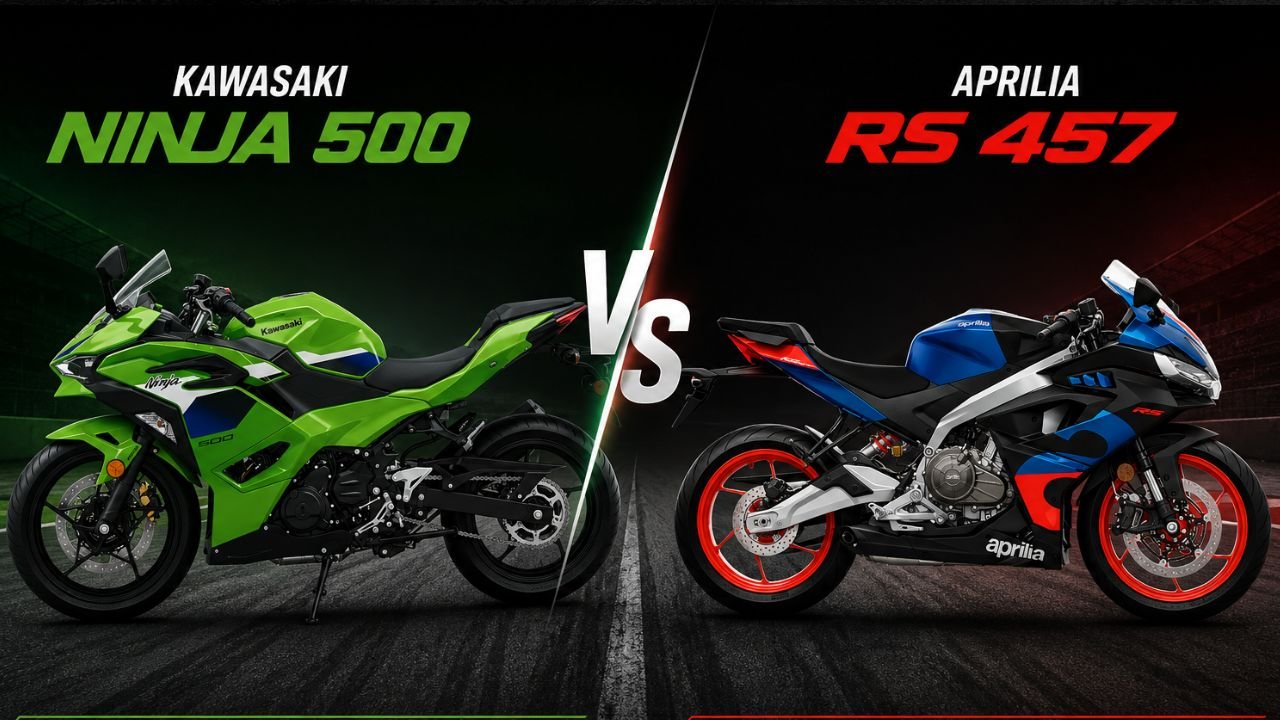
If you are shopping for a fully-faired middleweight sportbike in India in 2026, you will land on these two bikes. The Kawasaki Ninja 500 vs Aprilia RS 457 is the most talked-about comparison in this segment. Both use 450cc plus parallel-twin engines. Both are fully-faired sportbikes. Both target the same buyer. But they are very different in what they offer and what they cost.
Short answer: The Aprilia RS 457 wins on value, technology and performance. The Kawasaki Ninja 500 wins on comfort, lower seat height and brand heritage. The right choice depends completely on what matters more to you.
This is the full breakdown.
Kawasaki Ninja 500 vs Aprilia RS 457: Price
This is where the comparison starts getting uncomfortable for Kawasaki.
| Bike | Ex-Showroom Price |
|---|---|
| Kawasaki Ninja 500 (2026) | Rs 5.76 lakh |
| Aprilia RS 457 (2026) | Rs 4.22 to 4.37 lakh |
The Kawasaki Ninja 500 vs Aprilia RS 457 price difference is approximately Rs 1.4 to 1.5 lakh. That is not a small gap. That is the cost of a decent used scooter.
Why is the Ninja 500 so much more expensive? The Kawasaki Ninja 500 comes to India as a CBU, meaning Completely Built Unit. It is imported as a finished motorcycle and attracts heavy customs duty. The Aprilia RS 457 is locally assembled in India at the Piaggio plant in Pune, which keeps the import duty lower.
Both bikes attract 40 percent GST because they are above 350cc. But the CBU surcharge on the Ninja 500 is what pushes its price up by over a lakh compared to what it would cost if it were assembled here.
For our detailed review of the Ninja 500 individually, read our 2026 Kawasaki Ninja 500 price and specs article.
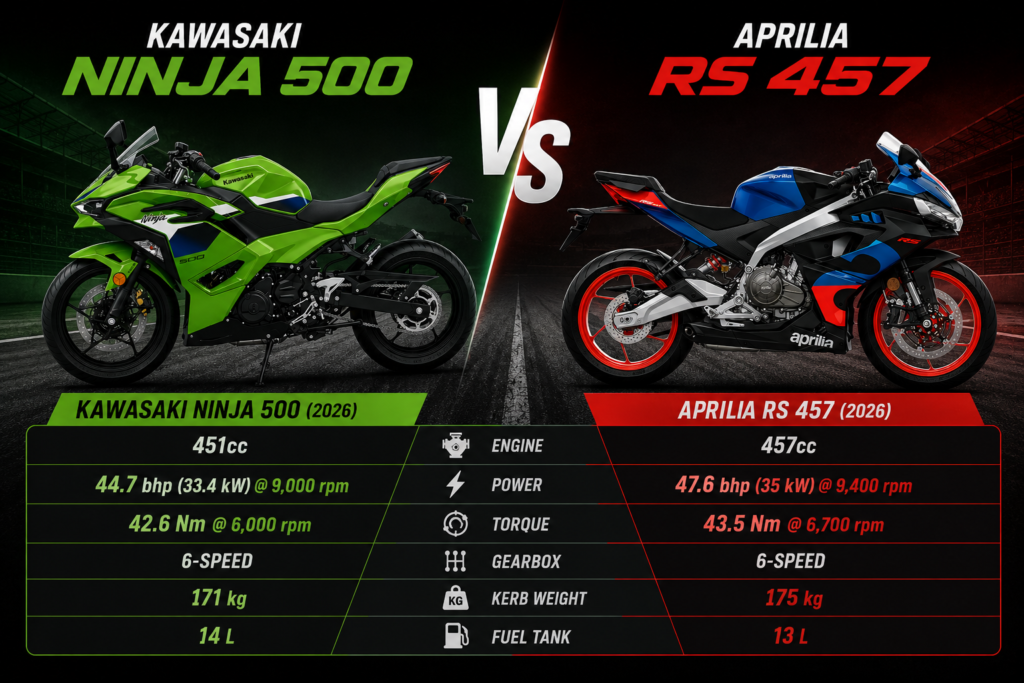
Quick Specs Comparison: Ninja 500 vs RS 457
| Specification | Kawasaki Ninja 500 | Aprilia RS 457 |
|---|---|---|
| Engine | 451cc, parallel-twin | 457cc, parallel-twin |
| Power | 45 PS at 9,000 rpm | 47.6 PS |
| Torque | 42.6 Nm at 6,000 rpm | Not specified officially |
| Frame | Steel trellis | Aluminium |
| Front fork | 41mm conventional, non-adjustable | 41mm, preload adjustable |
| Front brake | 310mm disc, 2-piston caliper | 320mm disc, ByBre radial 4-piston |
| ABS | Dual-channel, rear non-switchable | Dual-channel, dual-mapping, front-only option |
| Traction control | No | Yes, 3 settings |
| Riding modes | No | Yes, 3 modes |
| Quickshift | No | Optional (Rs 18,898 extra) |
| Display | LCD (negative) | 5-inch colour TFT |
| Seat height | 785mm | Approx 820mm |
| Dry weight | 157 kg | 159 kg |
| Kerb weight | 171 kg | Not specified |
| Fuel tank | 14 litres | 15 litres |
| Price | Rs 5.76 lakh | Rs 4.22 to 4.37 lakh |
Engine Comparison: Kawasaki Ninja 500 vs Aprilia RS 457
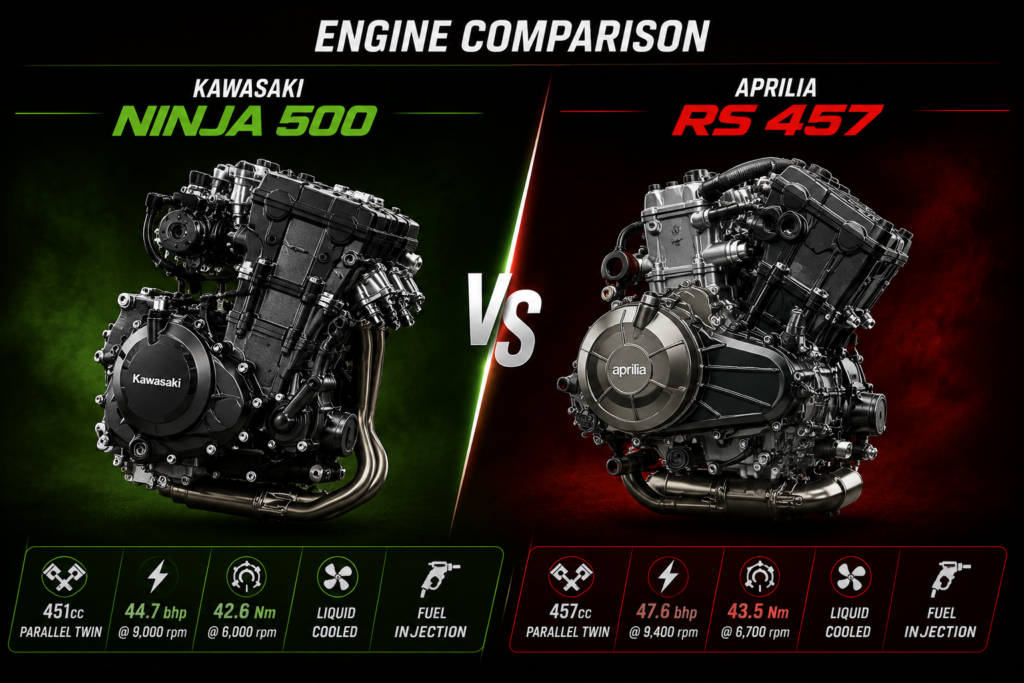
Both bikes use liquid-cooled, DOHC, parallel-twin engines with 4 valves per cylinder. On paper they look similar. In character, they are quite different.
Kawasaki Ninja 500 engine: 451cc, 45 PS at 9,000 rpm, 42.6 Nm at 6,000 rpm. Fuel injection with 32mm twin throttle bodies. The power delivery is smooth and linear. It builds from the low end and stays predictable all the way through. Not exciting. Not sudden. Just solid and accessible. Good for everyday use and first-time twin-cylinder riders.
Aprilia RS 457 engine: 457cc, 35 kW which works out to approximately 47.6 PS. The Aprilia uses Ride by Wire technology, which means the throttle is electronic with no direct cable. This is what enables the 3 riding modes and traction control to work. The engine has a sharper, more responsive character than the Ninja 500.
Winner on power and tech: Aprilia RS 457. More power, electronic throttle, riding modes and traction control. Winner on accessibility: Kawasaki Ninja 500. Smoother, more predictable, easier for less experienced riders.
Suspension Comparison
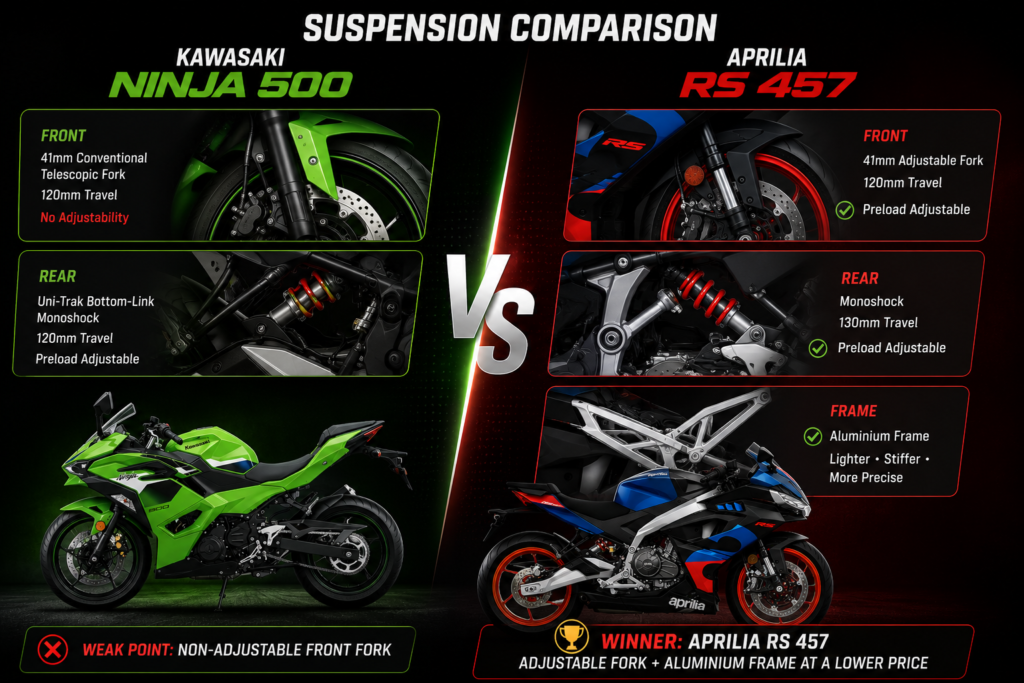
Kawasaki Ninja 500: 41mm conventional telescopic fork at the front with 120mm travel. No adjustability. Rear uses the Kawasaki Uni-Trak bottom-link system with a gas-charged monoshock with spring preload adjustability and 130mm of travel. The front fork is the weak point here for a bike at Rs 5.76 lakh.
Aprilia RS 457: 41mm adjustable fork at the front with 120mm travel. The front fork here has preload adjustment. Rear monoshock also offers 130mm travel with adjustment. The RS 457 also uses an aluminium frame versus the steel trellis on the Ninja 500. Aluminium is lighter and stiffer, which gives the bike a more precise and connected feel.
Winner: Aprilia RS 457. Adjustable front fork and aluminium frame at a lower price point is a clear win.
Brakes Comparison
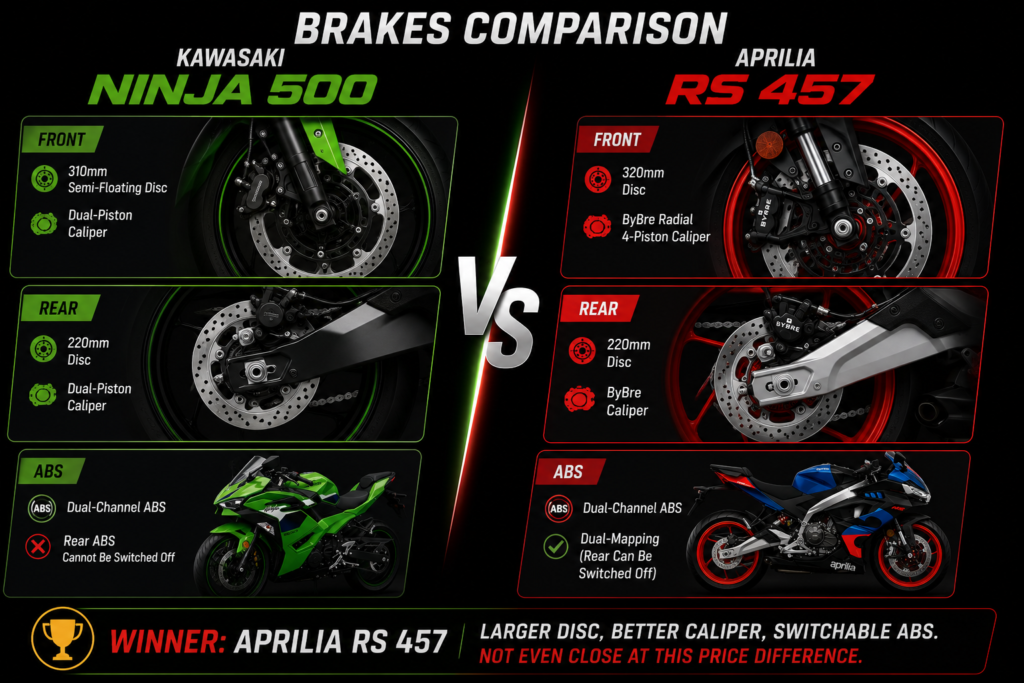
This is one of the clearest wins for the Aprilia in the Kawasaki Ninja 500 vs Aprilia RS 457 comparison.
Kawasaki Ninja 500: 310mm semi-floating front disc with a balanced actuation dual-piston caliper. 220mm rear disc with dual-piston caliper. The 2-piston front caliper is basic for this price point. Dual-channel ABS is standard but the rear ABS cannot be switched off, which is a limitation.
Aprilia RS 457: 320mm front disc with a ByBre radial-mount 4-piston caliper. ByBre is a high-quality brake brand. Radial-mount 4-piston setup gives better braking feel, more bite and better heat management. 220mm rear disc with ByBre caliper. Dual-channel ABS with dual-mapping. You can set it to front-wheel only if you want more rear wheel freedom.
Winner: Aprilia RS 457. Larger disc, better caliper, switchable ABS. Not even close at this price difference.
Features and Electronics Comparison
This is where the Aprilia RS 457 absolutely runs away from the Ninja 500.
Kawasaki Ninja 500 features:
- Negative LCD display
- Bluetooth connectivity via RIDEOLOGY THE APP
- ECO indicator
- Assist and slipper clutch
- All-LED lights
- No traction control
- No riding modes
- No quickshift
- No TFT display
Aprilia RS 457 features:
- 5-inch full colour TFT display
- Ride by Wire electronic throttle
- 3 riding modes (Sport, Road, City)
- Traction control with 3 settings
- Dual-channel ABS with dual-mapping
- Backlit handlebar switches
- Quickshift available as factory option (Rs 18,898 extra)
- All-LED lights
At Rs 5.76 lakh, the Ninja 500 gives you a basic LCD screen and no electronic rider aids. The Aprilia RS 457 at Rs 4.37 lakh gives you a TFT display, riding modes, traction control and switchable ABS. In 2026, this gap in features for a bike that is Rs 1.5 lakh more expensive is very hard to defend.
Winner: Aprilia RS 457. By a large margin.
Weight and Seat Height Comparison
This is one area where the Kawasaki Ninja 500 genuinely wins.
Kawasaki Ninja 500: Dry weight 157 kg. Kerb weight 171 kg. Seat height 785mm. The seat is also narrow and slim at the rear, which means your feet reach the ground without the bike’s width getting in the way.
Aprilia RS 457: Dry weight 159 kg. Seat height approximately 820mm. That is 35mm taller than the Ninja 500. For many Indian riders, especially those under 5’7″, this makes a real difference in confidence at traffic stops.
Winner: Kawasaki Ninja 500. Lower seat height and lighter kerb weight make it more approachable for everyday Indian riding.
If you want to understand how seat height affects real-world usability, also check our Triumph Bonneville 400 review where we cover the same topic for a different segment.
Ergonomics and Riding Position
Kawasaki Ninja 500: Semi-upright riding position. The handlebars are elevated and the footpegs are not too far back. It is a comfortable sporty position, not an aggressive racer crouch. Riders who spend long hours on the bike will appreciate this. Kawasaki’s ERGO-FIT system also lets you adjust handlebar and footpeg positions.
Aprilia RS 457: More committed sportbike position. The semi-handlebar setup is above the steering yoke but it is still a slightly more aggressive lean than the Ninja 500. Better for spirited riding, slightly less comfortable on long highway trips.
Winner: Kawasaki Ninja 500 for comfort. Aprilia RS 457 for sport feel.
Real-World Performance in India
Both bikes handle Indian road conditions well due to their relatively low weight and 17-inch wheel setup with 110/70 front and 150/60 rear tyres. Ground clearance on the Ninja 500 is 145mm, which is adequate but not exceptional on very broken roads.
The Ninja 500’s linear engine character makes it easy to use in city traffic. The RS 457’s riding modes help too, especially City mode which softens throttle response for crowded urban areas.
On highways, the Ninja 500’s comfortable ergonomics let you cover longer distances without fatigue. The RS 457 will feel more exciting but tiring over very long stretches.
For an idea of how Indian bikes in a similar price range perform on the road, also read our 2026 Suzuki Gixxer 250 price and specs article to understand the performance gap between 250cc and 450cc parallel-twins.
Service and Ownership Costs
Kawasaki Ninja 500: Kawasaki has a smaller dealer and service network in India compared to Japanese mass-market brands. In major cities there are authorised service centres but in tier 2 and tier 3 cities you may need to travel. Spare parts are imported and can take time. Service costs are moderate.
Aprilia RS 457: Aprilia’s service network in India is also limited but has been growing through the Piaggio group infrastructure. Available in major cities. The advantage here is that the RS 457 is assembled in India so parts availability for common items is better than the Ninja 500’s CBU situation.
Winner: Slight edge to Aprilia RS 457 on parts availability since it is locally assembled.
Who Should Buy the Kawasaki Ninja 500?
Buy the Kawasaki Ninja 500 if:
- Your height is under 5’6″ and you want the lowest possible seat height in this segment
- You are a new rider moving up from a 150cc to 250cc bike and want something friendly and forgiving
- You love the Kawasaki Ninja brand identity and the Lime Green colour matters to you
- You do mostly city riding and long highway touring where a relaxed position helps
- Budget is not the primary concern and you want a reliable, simple bike with a strong brand name
Who Should Buy the Aprilia RS 457?
Buy the Aprilia RS 457 if:
- You want the best technology in this segment at the lowest price
- You ride spiritedly and want traction control, riding modes and proper sportbike electronics
- You can manage a 820mm seat height comfortably
- You want the better brakes setup with a ByBre 4-piston radial caliper
- Rs 1.5 lakh savings matters to you and you want to put that money into accessories or quickshift
Kawasaki Ninja 500 vs Aprilia RS 457: Final Verdict
| Category | Winner |
|---|---|
| Price | Aprilia RS 457 |
| Engine performance | Aprilia RS 457 |
| Frame and chassis | Aprilia RS 457 |
| Suspension | Aprilia RS 457 |
| Brakes | Aprilia RS 457 |
| Electronics and features | Aprilia RS 457 |
| Seat height | Kawasaki Ninja 500 |
| Kerb weight | Kawasaki Ninja 500 |
| Riding comfort | Kawasaki Ninja 500 |
| Brand heritage | Kawasaki Ninja 500 |
On paper, the Aprilia RS 457 wins 6 out of 10 categories and is Rs 1.5 lakh cheaper. That is a very strong result for Italian engineering assembled in Pune.
But bikes are not bought purely on spreadsheets. The Kawasaki Ninja 500 has something the RS 457 cannot match: the Lime Green colour, the Ninja badge, and the globally recognised Kawasaki sportbike heritage. For many buyers in India, that matters.
If you are buying with your head: buy the Aprilia RS 457. Better bike, lower price.
If you are buying with your heart and the Ninja badge means something to you: buy the Kawasaki Ninja 500. Just know exactly what you are paying extra for.
Neemoto Verdict: Aprilia RS 457 4 out of 5 | Kawasaki Ninja 500 3.5 out of 5
FAQ: Kawasaki Ninja 500 vs Aprilia RS 457
Which is better, Kawasaki Ninja 500 or Aprilia RS 457? The Aprilia RS 457 is the better bike on specs, features and value. It is cheaper, has more electronics, better brakes and a stiffer aluminium frame. The Kawasaki Ninja 500 wins on lower seat height, lighter feel and brand appeal.
What is the price difference between Kawasaki Ninja 500 and Aprilia RS 457? The Kawasaki Ninja 500 is priced at Rs 5.76 lakh ex-showroom. The Aprilia RS 457 is priced at Rs 4.22 to 4.37 lakh ex-showroom. The difference is approximately Rs 1.4 to 1.5 lakh in favour of the Aprilia.
Does the Kawasaki Ninja 500 have traction control? No. The Kawasaki Ninja 500 does not have traction control. The Aprilia RS 457 has traction control with 3 settings as standard.
Which has a lower seat height, Ninja 500 or RS 457? The Kawasaki Ninja 500 has a seat height of 785mm. The Aprilia RS 457 has an approximately 820mm seat height. The Ninja 500 is 35mm lower, which makes it significantly more accessible for shorter riders.
Which is lighter, Ninja 500 or RS 457? Both have similar dry weights. Ninja 500 is 157 kg dry and 171 kg kerb. Aprilia RS 457 is approximately 159 kg dry. The Ninja 500 is slightly lighter overall.
Does the Aprilia RS 457 have riding modes? Yes. The Aprilia RS 457 has 3 riding modes: Sport, Road and City. The Kawasaki Ninja 500 has no riding modes.
Which has better brakes, Ninja 500 or RS 457? The Aprilia RS 457 has clearly better brakes. It uses a 320mm disc with a ByBre radial-mount 4-piston caliper. The Ninja 500 uses a 310mm disc with a basic 2-piston caliper.
Is the Kawasaki Ninja 500 E20 compatible? Yes. The 2026 Kawasaki Ninja 500 is fully E20 fuel compliant. Read our full Kawasaki Ninja 500 2026 review for complete details.