
Ever rolled up to a petrol pump with ₹500 in your wallet, only to cringe at the price per litre? You’re not alone! Today’s petrol price is on everyone’s mind, especially as global events make the petrol pump feel like a surprise party (and not a fun one). In India, rates change every day and vary widely – Delhi’s around ₹94.77/L (one of the lowest) while Hyderabad’s about ₹107.50/L (the priciest). We’ll chat about what’s behind today’s petrol price, the city and state breakdown, and even how Middle East news might squeeze your fuel costs. No dry textbook here – just friendly tips and facts to keep you in the loop (and save you a few rupees).
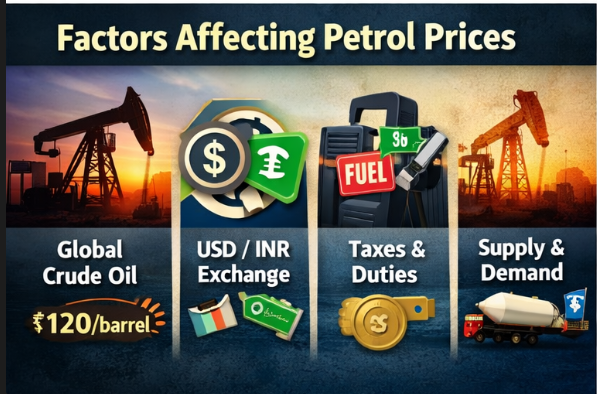
Car fuel is like a cocktail of factors: crude oil prices, currency swings, government taxes, and local costs all thrown in. Here’s a quick taste of what shapes the price at your pump:
- Global crude oil price: The biggest driver. When Brent crude spikes on world markets, your pump price often follows. Last week, Brent shot near $120/barrel amid Middle East tensions. Ouch!
- Exchange rate: India imports almost 90% of its oil. So if the rupee weakens against the dollar, imported fuel gets costlier.
- Taxes (central & state): These add a lot. Excise duty and VAT can double the base price. Different states have different VAT rates, so prices can vary a lot by state.
- Local costs & demand: Transport to refineries, dealer margins, even how many vehicles are on the road can tweak the final number. A long pipeline and lots of trucks pumping fuel adds cost.
Fuel companies (IOC, BPCL, HPCL) update rates daily based on yesterday’s market info. That’s right – when you wake up, the pump may have a new price. Thankfully, India cut fuel taxes in 2022, so prices have been relatively stable recently. But we still watch those global headlines – a war scare or OPEC cut can send shockwaves to the pump (more on that below).
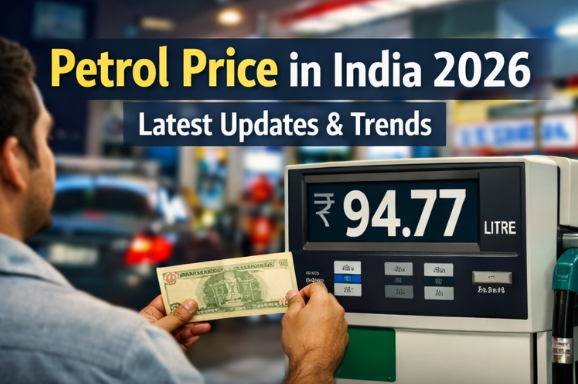
Why Petrol Prices Change Daily
Think of petrol price like a stock ticker for fuel. Every evening, Oil Marketing Companies recalc rates for the next day. They take the international crude price (which updates all day), convert it with the latest USD/INR rate, add refining/transport costs, and then layer taxes on top. The result shows up on your pump by morning.
Even with daily changes, India’s petrol prices have been surprisingly calm lately. After mid-2022 tax cuts, the central and state duties were slashed, and prices saw limited movement. For now we’re in a flat period: “petrol and diesel prices in India have remained largely stable in recent years”. But stability doesn’t mean zero drama. Global events can still jolt the base price that next week’s rates are built on.
A quick rundown of daily drivers of petrol price:
- International oil markets: Crude oil is the raw stuff for petrol. If Brent or WTI oil rockets up, the base cost goes up. (Recently, Reuters noted Brent hit four-year highs above $119/barrel before easing back.)
- Dollar–rupee rate: A weaker rupee makes each barrel cost more rupees. Imagine having to pay in dollars with fewer rupees in hand – pump prices climb.
- Taxes and margins: Central excise duty and state VAT taxes are fixed per litre. State governments can quickly change their VAT rates if they want – that’s why petrol costs differ from state to state. Dealers and retailers also add a fixed margin.
- Demand and supply quirks: Festivals, harvest season, rains – if lots of people suddenly need petrol (or it’s hard to ship in), it can nudge up the rate.
In short, what you pay at the pump = crude price + conversion + refining + distribution + taxes. It’s a lot of moving pieces, and they update regularly to keep pace with global markets.
India’s Petrol Price Today: City & State Breakdown
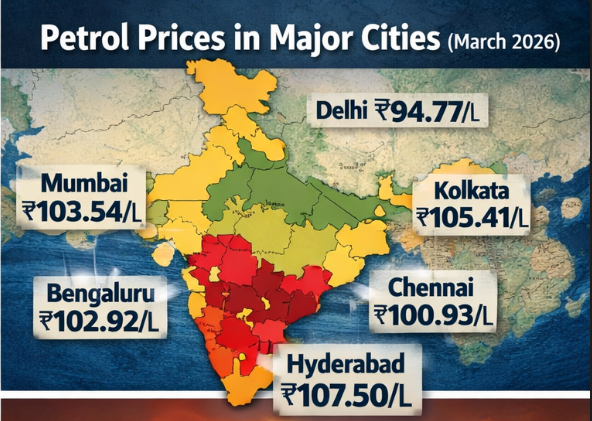
So, what are we talking about today? Here’s a snapshot of petrol prices (₹/L) around India as of mid-March 2026:
- Delhi: ₹94.77 – still the cheapest of the major metros.
- Bengaluru: ₹102.92.
- Chennai: ₹100.93.
- Hyderabad: ₹107.50 – the priciest big city.
- Kolkata: ₹105.41.
- Mumbai: ₹103.54.Source
Source: Click Here
In Delhi, petrol has stayed below the ₹100 mark, but most other metros are above it. Hyderabad tops out around ₹107.5, followed by Kolkata (₹105) and Mumbai (₹103). These city prices were steady on March 12 (no daily change).
Why the big gap? It all comes back to taxes and cost of supply. State taxes and local fees differ. For example, Andhra Pradesh was charging about ₹108.97/L (highest) on that day, whereas Andaman & Nicobar Islands was only ₹82.46/L (the lowest). That’s a ₹26 difference in one litre just because of location! As the Times of India notes, fuel price variation across India is largely due to local VAT, transport costs, and levies.
Diesel is generally cheaper (mostly under ₹100/L in big cities), but petrol above ₹100 has become common outside Delhi. Key points from recent data:
- Highest petrol (state): Andhra Pradesh ~₹108.97/L.
- Lowest petrol (state): Andaman ~₹82.46/L.
- Metro range: ~₹94.8 (Delhi) to ₹107.5 (Hyderabad).
- Diesel: ₹87–96/L range in major cities.
So if you fill up in Delhi, your litre might be around ₹94–95, but in Hyderabad it could push past ₹107. Ouch, right? That’s why friends in different cities argue about whose petrol bill is bigger.
Global Events: How Middle East Tensions Affect Prices

What about global oil drama? The recent US–Israel–Iran war scare has stirred the pot. Oil is traded globally, so any threat to supply (like tensions in the Gulf or a Strait of Hormuz blockade) can spike prices overnight. We saw this: Brent crude shot up above $119/barrel in early March (highest since mid-2022), before calming to the high-$80s.
International news had petrol owners biting nails: would prices skyrocket? In practice, India managed to keep retail prices steady despite the spike. The government and oil companies absorbed much of the cost increase for now. Part of how India coped: we have big reserves (250+ million barrels, roughly 7-8 weeks of supply) and have bought a lot of cheaper Russian crude lately. That cushion helped; the Times of India notes India held unchanged for now, while neighbors had sharper pain.
For context, Pakistan did raise its fuel prices: petrol jumped by 55 rupees to ₹321.17/L (because they couldn’t hide the global increase), and Bangladesh is rationing fuel. India’s bigger stash and policy moves meant we escaped immediate hikes on March 12.
That said, global prices did make a dent in our feelings. Oil experts warn volatility is high. For example, trading forecasts see Brent around $95/barrel even if things cool, due to war-related cuts. If a conflict drags on, Aramco (Saudi Arabia) warns of “catastrophic” impact on supply. So, the pump price can react if crude stays high. As of now, though, India’s daily pump price still mostly reflects “yesterday’s news,” and big jumps have been delayed.
In a nutshell:
- Global crude surges: If war or OPEC cuts send oil up (like the recent spike to ~$120), expect potential pressure on your petrol price.
- India’s buffer: Large reserves and some policy to absorb shocks means pump prices can lag behind the global swing.
- Neighbor differences: Unlike India, Pakistan passed on a big hike immediately. We avoided that, but rumors swirl that future adjustments are not ruled out if high prices persist.
Keep an eye on international cues (war updates, OPEC news) – they often peek through in your receipt a week later.
Tips to Save on Fuel
Feeling pinched by petrol prices? Here are some free ways to lighten your fuel bill:
- Carpool or use transit. Sharing rides with coworkers or neighbors means you split the cost. One car instead of two makes your petrol stretch more, and hey, you’ll have company on the way. Public buses and metros are great for some trips too.
- Drive gently. Avoid sudden starts and stops. Easy acceleration uses less petrol, and steady speeds are kinder to mileage. Think of it like a gentle bike ride, not a drag race – your engine (and wallet) will thank you.
- Maintain your vehicle. A well-tuned engine, clean air filter, and correct tyre pressure make a big difference. Under-inflated tyres waste fuel (they drag on the road), so keep them topped up. Regular servicing can boost efficiency by a few percent.
- Plan your trips. Instead of five quick errands, combine them into one longer trip. Cold engines and short hops burn more fuel per km. One longer trip (when the engine is warm) is more efficient.
- Lighten the load. Extra weight (like a heavy roof rack or packed trunk) makes your car gulp more petrol. Only carry what you need. And at low speeds, try turning off the AC or opening a window – though at high speed, the AC might be better for fuel economy.
Try these out: maybe one tank will last that much farther. Your future self (and your pocket) will appreciate it.
FAQs
Q: What is today’s petrol price in India?
A: Prices change daily. As of March 12, 2026, Delhi’s rate is about ₹94.77/L and most other major cities are above ₹100/L. For example, Mumbai is ~₹103.54/L and Kolkata ~₹105.41/L. Check local news or official oil company websites for the latest city-wise rates.
Q: Why do petrol prices change every day?
A: Fuel rates in India are updated daily by the oil companies. Each day’s international crude oil price and the USD/INR exchange rate (from the previous day) are factored in. So when global oil moves or the rupee shifts, the next day’s petrol price can go up or down accordingly.
Q: Do global events like the Iran war affect petrol price?
A: Yes. India imports most of its oil, so global supply disruptions (like conflicts in the Middle East) can push up crude prices. In mid-March 2026, tensions did spike crude to ~$120/barrel. India buffered some of that increase, so domestic petrol stayed steady for now. However, if tensions persist, you may see higher prices later.
Q: Why are petrol prices different across states?
A: Because each state adds its own VAT and taxes on top of the base price. For example, one liter in Andhra Pradesh might be ~₹109, while in Andaman it’s ~₹82, mainly due to different state levies and delivery costs.
Q: How often are fuel prices updated?
A: Fuel prices are revised every day, usually at midnight. So the rates you see at morning are based on the previous day’s market data. That means a price hike at the global level might show up in your local station the next day (or next few days).